
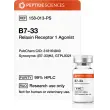
Peptide Sciences USA
B7-33 6 mg
- Active Substance: Relaxin Receptor 1 Agonist
- Concentration: 6 mg per vial
- Pack Size: Single vial (lyophilized powder)
- Manufacturer: Peptide Sciences USA
- Brand Name: B7-33
- Molecular Formula: C127H212N44O34
- Molecular Weight: ~2951 Da
- Sequence: VIKLSGRELVRAQIAISGMSTWSKRSL
- Synonyms: (B7-33)H2, Single-Chain Relaxin Analog, GTPL9321
B7-33 6 mg – Revolutionize Anti-Fibrotic and Cardioprotective Research
Product Summary
Envision a research breakthrough that halts fibrosis, protects the heart, and reduces inflammation. B7-33 6 mg vial from Peptide Sciences USA, a single-chain relaxin receptor 1 (RXFP1) agonist, delivers these possibilities. This peptide mimics the anti-fibrotic and cardioprotective effects of human relaxin-2 without tumor-promoting risks, offering a powerful tool for exploring solutions to heart failure, lung disease, and kidney fibrosis.
How B7-33 Works
B7-33 is a synthetic, single-chain peptide derived from the B-chain of human relaxin-2 (H2 relaxin) with the sequence VIKLSGRELVRAQIAISGMSTWSKRSL. It acts as a functionally selective agonist of the relaxin family peptide receptor 1 (RXFP1), preferentially activating the extracellular signal-regulated kinase (Erk1/2) pathway over cyclic adenosine monophosphate (cAMP). This biased signaling avoids the tumor-promoting effects associated with cAMP activation by H2 relaxin. B7-33 binds RXFP1, often forming heterodimers with angiotensin II type 2 receptor (AT2R), to upregulate matrix metalloproteinase-2 (MMP-2), a collagen-degrading enzyme, and promote vasodilation via nitric oxide synthase activation.
In preclinical studies, B7-33 reduced myocardial infarct size and fibrosis in mouse models of ischemia-reperfusion injury, achieving up to 50% reduction in scar formation within 7 days at 0.25–0.5 mg/kg/day. It also reversed airway fibrosis in ovalbumin-induced lung disease models and improved kidney function by increasing renal blood flow. Its short half-life (~6 minutes in vitro) is offset by rapid tissue penetration, making it ideal for targeted research applications.
Why Choose B7-33?
B7-33 is a game-changer for research into fibrosis, heart health, and inflammation. Here's why it stands out:
- Anti-Fibrotic Power: Reduces scar formation by up to 50% in heart and lung models by upregulating MMP-2, reversing fibrosis in preclinical studies.
- Cardioprotection: Decreases infarct size and preserves cardiac function post-ischemia-reperfusion, offering potential for heart failure research.
- Anti-Inflammatory Effects: Inhibits proinflammatory cytokines, supporting research into chronic inflammatory conditions like sarcoidosis.
- Safer Profile: Avoids cAMP-mediated tumor promotion seen with H2 relaxin, making it suitable for long-term studies.
- High Purity: Peptide Sciences USA ensures 99% purity through advanced synthesis, guaranteeing reliable research outcomes.
B7-33 6 mg empowers researchers to explore innovative solutions for fibrosis, cardiovascular health, and immune modulation, backed by cutting-edge science.
Product Specifications
Peptide Sciences USA's B7-33 6 mg vial is designed for precision in anti-fibrotic and cardioprotective research, offering unmatched quality. Here's the breakdown:
- Composition: Contains 6 mg of B7-33 (C127H212N44O34, molecular weight ~2951 Da), a single-chain RXFP1 agonist.
- Pack Size: Single vial of lyophilized powder, requiring reconstitution for subcutaneous or intraperitoneal injection.
- Manufacturing: Produced by Peptide Sciences USA with 99% purity, verified by High-Performance Liquid Chromatography and Mass Spectrometry.
- Usage Guidelines: Reconstitute with bacteriostatic water and administer subcutaneously or intraperitoneally, typically at 0.25–0.5 mg/kg/day in research protocols (). Use under professional supervision.
- Storage: Store lyophilized powder at -20°C. After reconstitution, refrigerate at 2–8°C and use within 30 days.
- Safety: No significant side effects reported in preclinical studies; limited human data requires research oversight.
This peptide is for research purposes only, offering a reliable platform for studying fibrosis and cardiovascular health.
Legal Disclaimer
B7-33 6 mg is supplied for research purposes only and is not FDA-approved for human use. It is not intended to diagnose, treat, cure, or prevent any condition. Consult a licensed professional before use. Peptide Sciences USA assumes no liability for misuse. All information is educational and based on preclinical research.
Frequently Asked Questions
What does B7-33 do?
B7-33 is a selective RXFP1 agonist that reduces fibrosis, protects cardiac tissue, and modulates inflammation. It activates Erk1/2 signaling to upregulate MMP-2, degrading collagen in fibrotic tissues, and supports vasodilation for cardiovascular health.
What are the benefits of B7-33?
B7-33 reduces scar formation by up to 50% in heart and lung models, decreases infarct size post-ischemia, improves kidney function, and inhibits inflammation, making it ideal for researching heart failure, lung disease, and fibrosis.
What is the half life of B7-33?
B7-33 has a short in vitro serum half-life of approximately 6 minutes, though tissue penetration is rapid. Lipidated analogs can extend this to ~60 minutes, but this product is the unmodified form.
What are possible side effects of B7-33?
Preclinical studies report no significant side effects, with no evidence of tumor promotion unlike H2 relaxin. Limited human data necessitates professional oversight for research use.
How is B7-33 administered?
B7-33 is supplied as a 6 mg lyophilized powder. Reconstitute with bacteriostatic water and administer subcutaneously or intraperitoneally, typically at 0.25–0.5 mg/kg/day in research protocols, under professional guidance.
Related Products