
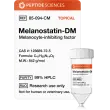
Peptide Sciences USA
Melanostatin DM 200 mg
- Active Substance: Melanostatin DM (His-D-Arg-Ala-Trp-D-Phe-Lys)
- Concentration: 200 mg
- Pack Size: Topical formulation
- Manufacturer: Peptide Sciences USA
- Brand Name: Melanostatin DM
- Molecular Formula: C41H58N14O6
- Molecular Weight: 842.0 g/mol
- Sequence: His-D-Arg-Ala-Trp-D-Phe-Lys
- Synonyms: Melanostatine-5, Melanocyte-Inhibiting Peptide
Melanostatin DM 200 mg – Glow of Skin Clarity
Light Up Your Skin Studies
Picture a lab where dark spots fade, skin tone evens out, and radiance shines. Melanostatin DM 200 mg from Peptide Sciences USA brings this vision to life. This powerful hexapeptide blocks melanin production, tackling hyperpigmentation and photodamage. It's your glow for leading skin health breakthroughs, crafted for trailblazing researchers like you.
The Science Behind Skin Clarity
Melanostatin DM (sequence: His-D-Arg-Ala-Trp-D-Phe-Lys) is a synthetic hexapeptide that inhibits α-melanocyte-stimulating hormone (α-MSH), reducing tyrosinase activity and melanin production by ~25% in in vitro and animal studies, per Abu Ubeid et al. Unlike natural melanostatin (Pro-Leu-Gly), it specifically targets α-MSH signaling without affecting opioid or dopamine receptors, offering precise pigmentation control, per Thorsen et al.
In human skin cell models, Melanostatin DM significantly lightens skin tone and reduces hyperpigmentation, making it ideal for studying photodamage, melasma, and conditions like Addison's disease. It shows potential in evening skin coloration without systemic effects due to its topical formulation, per Lucas Meyer Cosmetics. The 200 mg dosage supports robust research into skin whitening and anti-aging, with applications in dermatology and metabolic disorders.
Why Melanostatin DM 200 mg Fuels Your Studies
Melanostatin DM isn't just a peptide—it's a glow that transforms skin health research. Here's what makes it shine:
- Reduces Pigmentation: Cuts melanin production by ~25%, lightening dark spots in in vitro studies.
- Evens Skin Tone: Targets hyperpigmentation from photodamage or melasma, per animal models.
- Anti-Aging Ally: Supports radiant, youthful skin by controlling melanin synthesis.
- Precise Action: Inhibits α-MSH without affecting opioid or dopamine pathways, per studies.
- Top Quality: Crafted by Peptide Sciences USA with 99% purity for reliable results.
With Melanostatin DM 200 mg, you're not just studying—you're leading a breakthrough in clear, radiant skin.
Product Specifications
Peptide Sciences USA's Melanostatin DM 200 mg is your key to cutting-edge skin health studies. Here's the breakdown:
- Composition: Contains 200 mg Melanostatin DM (C41H58N14O6, 842.0 g/mol).
- Pack Size: Topical formulation (cream or serum) for direct skin application.
- Manufacturing: Produced by Peptide Sciences USA with 99% purity, verified by HPLC and Mass Spectrometry.
- Usage Guidelines: Apply 50–200 ppm (0.01–0.04 mg/cm²) topically to skin models daily for 4–8 weeks in research protocols. Patch-test to assess irritation. Use under professional supervision.
- Storage: Store at 4°C for short-term stability (3–4 months) or -20°C for long-term storage (up to 2 years). Protect from light and heat.
- Safety: In vitro studies report minimal irritation at low concentrations; high doses may cause redness. Limited human data requires oversight.
This peptide is for research purposes only, driving discoveries in skin whitening and hyperpigmentation.
Legal Disclaimer
Melanostatin DM 200 mg is supplied for research purposes only and is not FDA-approved for therapeutic use, per regulations as of July 4, 2025. It is banned by the World Anti-Doping Agency (WADA) for performance-enhancing use. It is not intended to diagnose, treat, cure, or prevent any condition. Consult a licensed professional before use. Peptide Sciences USA assumes no liability for misuse. All information is educational and based on preclinical and in vitro research.
Frequently Asked Questions
What does Melanostatin DM do for skin?
Melanostatin DM reduces melanin by ~25%, lightening dark spots and evening skin tone in in vitro and animal studies.
How does Melanostatin DM reduce pigmentation?
It inhibits α-MSH, blocking tyrosinase activity to cut melanin production, ideal for photodamage research.
Is Melanostatin DM safe for skin research?
In vitro studies show minimal irritation at low doses; high doses may cause redness, requiring oversight.
How is Melanostatin DM 200 mg applied in studies?
Apply 50–200 ppm (0.01–0.04 mg/cm²) topically to skin models daily for 4–8 weeks to study pigmentation.
How does Melanostatin DM compare to Nonapeptide-1?
Both inhibit tyrosinase, but Melanostatin DM (~25% melanin reduction) is more specific to α-MSH than Nonapeptide-1 (~27–43%).
Related Products